TOOLS
Login to access your documents and resources.
Welcome to Nuveen
Select your preferred site so we can tailor your experience.
Select Region...
- Americas
- Asia Pacific
- Europe, Middle East, Africa
Select Location...
- Canada
- Latin America
- United States
- Australia
- Hong Kong
- Japan
- Mainland China
- Malaysia
- New Zealand
- Singapore
- South Korea
- Taiwan
- Thailand
- Other
- Abu Dhabi Global Market (ADGM)
- Austria
- Belgium
- Denmark
- Finland
- France
- Germany
- Ireland
- Italy
- Luxembourg
- Netherlands
- Norway
- Spain
- Sweden
- Switzerland
- United Kingdom
- Other
Real estate
Tracking the real estate energy transition
Head of Strategic Insights, Nuveen Real Assets
Head of Sustainability, Asia Pacific
18 Jun 2025
1 min. read
Despite considerable progress on decarbonisation over the past decade, the global built environment is currently not on track to become net zero carbon by 2050.
Realising a net zero carbon transition for the built environment will require critical objectives being met. Tracking indicators of progress towards these outcomes gives an idea of the pace of transition and if these goals are not reached, the transformation is unlikely to occur.
We have identified six indicators and classified them as an accelerant, bottleneck or neutral based on our assessment conducted in 2025.
Click the indicators below to explore highlights from the report:
Investor appetite
Investor appetite
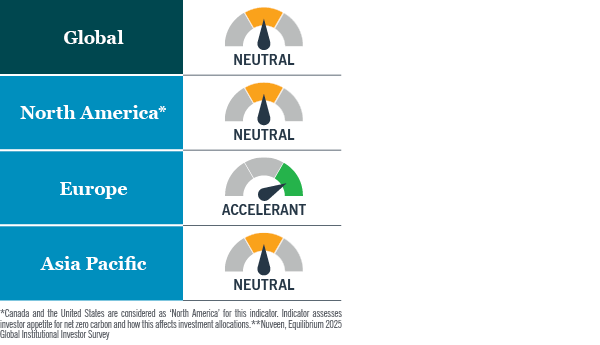
Investor allocations will be based on decarbonisation goals
- Investors continuing to allocate capital to low and zero carbon products is essential in supporting the transition
- Regional variances are quite stark, with U.S. investors less likely to give weight to ESG, climate risk and net zero carbon (NZC) factors than their EMEA or APAC counterparts
- Despite the ongoing consideration of NZC in allocations, investors do report seeing a slower pace to the energy transition than three years ago, with 61% responding that they see the transition to a low carbon economy as inevitable, down from 79% in 2023
The impact of investor appetite on the energy transition
Previous indicator
Next indicator
Grid decarbonisation
Electricity grids in specific regions will continue to decarbonise
- Global electricity grid carbon intensity has dropped 7% in the period of 2000-2023
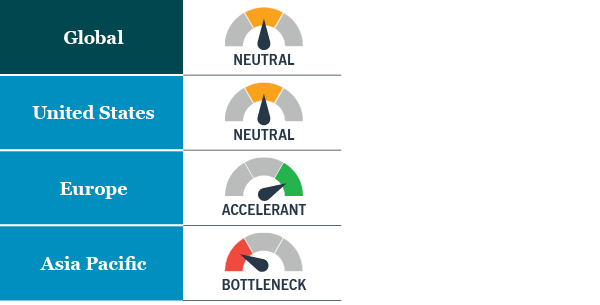
- The U.S. has led the way with a 35% reduction whilst Europe has cut 30%. Asia lags somewhat with a 6% reduction
- The outlook for grid decarbonisation remains positive as renewables capacity accelerates and coal is phased out. Future forecasts indicate that several markets are well-positioned to transition or have already met global requirements
- Buildings located in low carbon intensity grids will ultimately be cheaper to transition to net zero carbon, as they will not need to reach the same low levels of energy intensity to achieve net zero carbon standard
The impact of grid decarbonisation on the energy transition
Previous indicator
Next indicator
Supportive supply chain
Supply chain dynamics will support energy transition
- Real estate supply chains’ ability to deliver on net zero carbon is crucial to meeting ambitious targets
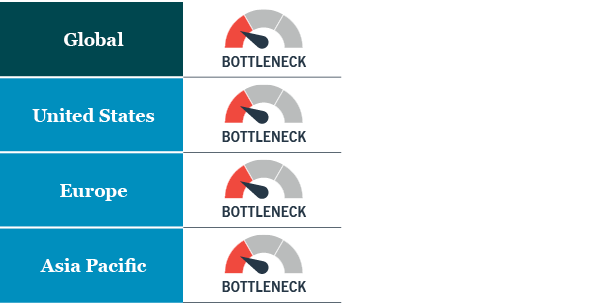
- Construction costs continue to track above inflation which leads to a bottleneck effect as necessary retrofits and building improvements become less commercially viable
- Lack of skills and costs of retrofitting buildings constrains the pace of transition
- Around 80% of buildings in cities today will remain in 2050. To meet the transition, retrofitting of older stock must increase from around 1% to 3% annually, a considerable increase
The impact of supply chain on the energy transition
Previous indicator
Next indicator
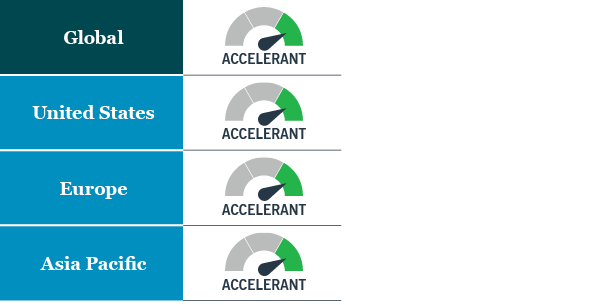
Cheaper technology
Cheaper technology
Technology to make buildings more energy efficient will continue to improve and reduce in cost
- Reducing energy demand from existing and new buildings is key to the transition
- To meet future projections, a further 44% reduction in energy intensity is required so continued innovation and cost reduction of technologies is paramount
- While costs continue to fall for key technologies, challenges persist with implementation due to costs of installation, need for upfront capital and installer availability. A further consideration of electrification is the cost of electricity, which in some cases can be higher than using natural gas
The impact of cheaper technology on the energy transition
Previous indicator
Next indicator
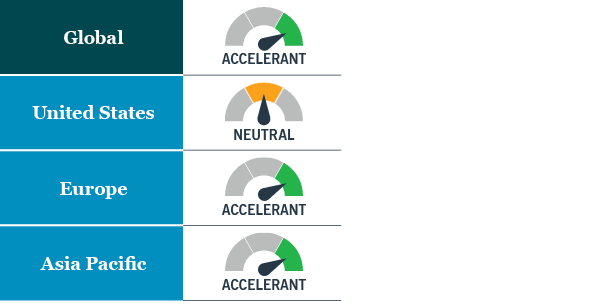
Tightening regulation
Building regulation around energy and carbon efficiency will strengthen
- Regulations supporting the low carbon transition have developed at pace with new disclosure, taxonomies, ratings and accounting standards introduced
- Europe will likely continue leading across the spectrum of regulation
- The Asia Pacific region currently has lower stringency of regulation, however, it is moving towards alignment with Europe, particularly in markets where Nuveen invests
- The outlook in the U.S. is complex. At a federal level it is unlikely that further regulation will be introduced. At city and state level it is more nuanced. Over 40 jurisdictions, accounting for almost 25% of U.S. building stock, have joined the National Building Performance Standards Coalition
The impact of tightening regulation on the energy transition
Previous indicator
Next indicator
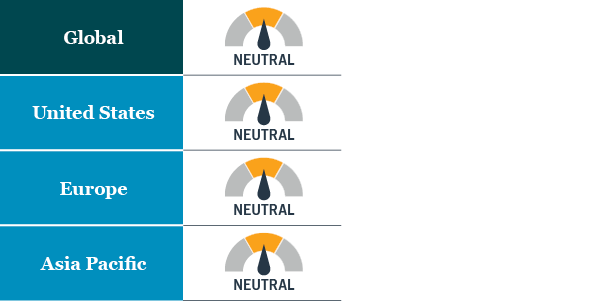
Occupier demand
Occupier demand
Occupiers’ net zero carbon goals will inform their space requirements
- Strong occupier demand is a crucial factor in decarbonising buildings
- In 2024, more than 7,300 companies representing over 40% of global market capitalisation had an approved Science Based Target in place. The number of signatories has risen exponentially
- This growth in occupier demand is being met by a limited supply of suitable assets. Recent data suggests a 70% supply shortfall in low carbon office buildings out to 2030
- The supply/demand dislocation can be seen to produce rental premiums in certain markets where data indicates premiums of 5-10% are possible
- When considering allocations, there are opportunities where a supply/demand imbalance exists
The impact of occupier demand on the energy transition
Previous indicator
Next indicator
About the authors
Learn more about our sustainability initiatives
Contact us
- London
- Abu Dhabi
- Amsterdam
- Copenhagen
- Frankfurt
- Hong Kong
- Tokyo
- Luxembourg
- Madrid
- Milan
- Paris
- Shanghai
- Singapore
- Stockholm
- Sydney
- Vienna
- Zurich
- +44 20 3727 8000
- 201 Bishopsgate, London, United Kingdom
- +971 2 3074036
- Unit 16, Level 7, Al Maryah Tower, Abu Dhabi Global Market Square, Al Maryah Island, Abu Dhabi, United Arab Emirates
- +31 20 259 5180
- Gustav Mahlerplein 66B, 1082 MA Amsterdam
- +45 3272 9903
- Bredgade 45 B 1, 1260 Copenhagen, Denmark
- +49 69 667736 871
- Junghofstraße 9, 60315 Frankfurt, Germany
- 1 Connaught Road Central, Hong Kong
- +81 3 4563 6250
- JP Tower, 18F, 2-7-2, Marunouchi, Chiyoda-ku, Tokyo, 100-7018, Japan
- +352 2487 1830
- 2, Rue Eugene Ruppert, Luxembourg
- +34 91 048 80 01
- Paseo de la Castellana 110, 3rd floor, 28046, Madrid, Spain
- +39 02 303 15640
- Via Monte Napoleone, 3 20121 Milano
- +33 1 73 00 08 29
- 7 Rue Scribe, Paris, France
- +8621 2331 0478
- Suite B01, 22/F, Jingan Kerry Centre Office Tower III, 1228 Middle Yan An Road, Jingan District Shanghai, China 200040
- One George Street, Singapore
- +46 8 505 30128
- Kungsgatan 30, Stockholm, Sweden
- 1 Macquarie Place, Sydney, Australia
- +43 1 205 22 750
- Wipplingerstraße 33/5. OG, Vienna, Austria
- Nuveen Switzerland GmbH, St. Annagasse 16, 8001 Zurich
4502237